Thursday, September 14, 2023

A Perfect Moment

Terry Pratchett is one of the amazing writers of all times.  The wit and depth of his writings are unique. I was reading his book The Thief of Time over the last few weeks. Last few weeks were interesting for me mixed with some issues following which I was also doing mindfulness-meditation more regularly. I guess that might have made me a bit more receptive. I read Terry talking about a perfect moment. (I am adding the exact lines below.)

This made me think what is a perfect moment? Let us think about this dispassionately and logically. A perfect moment. The word "perfect", as per Cambridge dictionary, means "complete and correct in every way, of the best possible type or without fault.

What is correct? Opinions and dogmas are personal. They can not be universally correct. In other words universality should be a property of anything that is correct. Hence, laws of nature can be called correct. When I lift a stone and leave it there, it falls down. That is a perfect piece of action. We do not have to think why I lifted the stone or if after falling it hit an ant. Just the falling of a stone is perfect. It follows the laws of nature perfectly. 

Now let us think of the tiniest moment we can think of. Everything in that moment follows the laws of nature. Good or bad comes when we attach temporal, personal and spatial contexts. A moment in itself is always perfect.

Let us try to do this small mental exercise when we can. Try to note the time flowing. Try to note things changing. In this flow, try to focus on the tiniest piece of time you can focus on. That "Tick" which can become your personal quanta of time. Everything in that "Tick", follows the laws of nature. Everything in that "Tick" is perfect. 

Every "Tick" is a perfect moment.

And as Terry says in that novel, 

"Against one perfect moment, the centuries beat in vain".


Sunday, September 03, 2023

Human Mind: Amplifier of Dukha

Prologue: The presence of Dukha (loosely translated as suffering or sorrow) is the first fundamental truth discovered by Sakya Muni Buddha. We all have Dukha to various intensities. However, the human mind is very good at amplifying the real Dukha. Let us talk about two incidents witnessed by the writer in the recent days.

Incident 1: You might remember Dr Samuel from the last two blogs. Early in August he got infected with flu (or Covid or Bronchitis) while providing healthcare in one of the rural shelters housing internally displaced people in Myanmar. Almost at the same time he joined a mobile team of healthcare providers whose mission was to travel and cover as much ground as possible to provide badly needed healthcare in the remote parts of the nation where hospitals have stopped working due to the ongoing freedom struggle. It can be mentioned here that even before this war healthcare in the remote parts of Myanmar (more than 70 percent of the nation) was extremely bare-bone. 

Anyway, the result was that the doctor who himself is sick had to travel everyday to a new location to provide healthcare to people who are in much more acute need of healthcare. Everyday morning the cough and flu would ameliorate a bit and he would travel to the next destination. And by the evening, cough would get worse. He had no rest, no decent bed, no decent hut with proper walls. He had no choice to not travel. Because, if he stops working then they can not cover the ground. 

The story does not end here. When he had very bad cough, he got the news that his sister who was suffering from cancer had died. And many more issues and challenges which I will not go into details here. Lets just say that he has been going through one of the worst phases of his life, challenges and issues which most of us can not even begin to comprehend. And, all these to be in the right side of history. 

Incident 2: I met a young man in a birthday celebration. This young man did his masters in the Netherlands. Then, he was not able to get a job for some time and now he is back in India living with his parents. Of course, he is sad. I thought knowing about people worse off than him may make him count his blessings. Me and my cousin sister (whose daughter’s birthday it was) tried to tell him about Dr Samuel and the endless list of challenges he has been going through. It was surprising and shocking to see how little impression was made by Samuel's story on this gentleman. He thought his pain and sufferings are as bad or worse than those faced by Dr Samuel. 

Insight: Human brain is an amazing organ. We take whatever sorrow or issues we have and keep amplifying it till it fills each and every corner of our brain. It’s like lighting a candle in a mirror room. Multiple reflections make the whole room filled with the tiny light. Oscar Wilde once told, “I have faced many tragedies in my life. Some of them were real!”. 

I was fundamentally wrong in assuming that some sorrows or sufferings are less than others. Human mind makes sure that every sorrow and suffering fills in our whole mind. 


Animated picture of Dr Samuel providing healthcare in rural parts of Myanmar. This image was generated from a real photo using the AI app fotor.com . 


Thursday, August 10, 2023

Sleeping Sound Slumber

 We may remember Dr Samuel, the revolutionary, from my previous blog. He and his team live in a hut. Often, they have to move around to take care of the health of people in other villages and refugee camps. One day I wanted to see their beds. This is where they sleep. 

Sleeping place in the camp. 
It is just a plastic mat with pillow and blanket. I was quite shocked. This is not even a hut in its traditional meaning. It has no walls. It is basically a shabby camping site which they have adopted as their domicile for more than two years now. While I was digesting this I saw some pictures of the night life in Yangon. Hundreds of young people having "fun" as if everything is going great.

Club scenes in Yangon.

I asked the doctor, "is this the generation you are fighting for? How do they get sleep at night when most of the country is burning and millions have been made refugees? How do they get a good night's sleep when you guys are stuck in your plastic bed in open forests?" 

My karma-focussed upbringing made it painful to digest. This is not the first time though. I have seen many people doing bad-karma but having a great life. 

Many people claim that if your karma is pure and your conscious is strong then you get a good sleep at the end of the day. I always had my doubt. I was pretty sure that the dictator who ordered a genocide or the banker whose scams caused the loss of job for thousands also get pretty decent sleep. 

The doctor's answer game me a fresh paradigm. He told, "I am sure the club-going ones are also getting pretty decent sleep. But, Amit, we are not in a competition, are we? We all have our inherent nature, circumstances and dispositions. If I were to go to the club then, of course, I shall not get a good sleep. Because, my consciousness wants me to be in the right side. Mark that this is right side by my definition and disposition. Similarly, the club-going ones can not get a good sleep if they are to spend a night in my bed! We all are doing what our individual dispositions and circumstances make us capable of."

I really loved this explanation. It helped me answer my age old question about if people not doing seemingly good karma sleep a sound slumber. As long as we do what our natural disposition makes us do, we all will get a good night's sleep! The trick is to understand our true nature and true disposition (also called true "dharma" in the Hindu scripture Bhagawat Gita). Suddenly, I could clearly see the meaning of this line from Bhagawat Gita. 

Swadharme Nidhanam sreya; paradharma bhayAbaha||

(Better to die working as per your true disposition and nature than to act otherwise.)


Saturday, July 15, 2023

Living Anicca

Long back, I guess in 1997, I read a short story in one of the news papers. It introduced the idea of "anicca", which is a pivotal peg of Buddhist philosophy. In simple language, it means impermanence. I.e. nothing in life is going to last for ever. At a deeper level, it gets more complicated which I do not grasp yet. I have met many people who talk about impermanence. Adages like "nothing lasts for ever" are cliche. Rarely have I met anyone who lives the essence of "anicca". 

Then I met Dr Samuel (name changed for privacy reasons) who is a doctor from Myanmar. Samuel, like many professionals and common Burmese people, joined the civil disobedience movement (CDM) when the junta illegally took over power in Burma in 2021. Within a few months of it, it was clear that the junta will go to any extent to keep power. Many kept doing CDM and are still participating it. For those who may not be aware of the situation, many citizens in Burma are still participating in CDM. Many universities are closed for two years because of the motivated and passionate students who have chosen to do the right thing. At the same time, many decided to start an armed revolution as well. An armed revolution needs people from all walks. Dr. Samuel joined the revolution and has been near the frontline of conflict ever since. He, with his team of equally motivated volunteers, work tirelessly to provide invaluable medical aid to the civilians caught in the fights. They also do their best to help the ones injured in this unjust war.  

When I came to know Dr Samuel better, he was still in the camps. Within a week or so, he faced the following list of problems. 

  1. He got the news that his sister is suffering from 4th stage cancer. 
  2. He realised that he is penniless and can not contribute anything to the treatment. 
  3. He realised that he can not even spend much time with his sick sister. 
  4. He had constant arguments with his father who wanted him to return to mainstream and get amnesty. 
  5. In the same week, his account (with whatever was left off his savings from the times when he was working for a good salary) was frozen and he lost all his savings. 
One evening he was really stressed. I can not even imagine how can one go through so much stress. He was thinking to leave the revolution. I did not know what to tell. 

Then came the twist. He spent that whole evening listening to Buddhist talks and meditating. The following morning, he looked calm and happy. I asked what happened? He told, "everything is impermanent. Why am I worried so much? Life is not for ever as well. I can also die from a road accident. All that matters is that I be with the right side during this crisis."

And that was it. He was back to his smiling and happy self. 

Never have I ever seen a person living the essence of "anicca" the way Samuel did. He is an inspiration. May his sacrifice not go in vein. May Myanmar get the right leaders it deserves. 

PS: What is happening in Myanmar is NOT a civil war. It is a freedom struggle. Please use the right words. Words have power.


Tuesday, December 27, 2022

Reality of Rose

 In a previous blog, we discussed about pannati, mental models we create to perceive the world around us. Today, we shall take a deeper dive into this subject. My father often states that "a rose is made up of everything in the universe except the rose!" It took me a long time to appreciate this statement. 

If we look at a rose and think a bit, we can link every part of the universe to it. Each part of the universe (in both space and time) has played a small part in creating this beautiful flower that I hold in my hand. Any tiny change in the cosmic history or in the evolutionary history would have created something completely different. Then we can think of all the processes (social, economic, geographical, political) that has caused this flower to end up in my hand; viz. shipping across seas, going through different borders, coming to this form through hundreds of years of meticulous breeding by passionate farmers/clergies, all these and many more processes have given rise to this flower. We can also think of the soil, the water, the farmers, energy from sun etc. which created this flower. In a way, this rose that I hold in my hand is made up of everything in the universe except "rose". How? Because "rose" is not a physical thing. "Rose" is a mental model we have created to represent this thing that actually holds the whole universe in itself. Of course, this is not true only of the rose. We can consider any thing or any person or any animal or plant. The same logic can be applied. "Amit" (myself) is made up of everything in the universe except the pannati "Amit"!

From here, my father takes a leap. If we want to make a nice dish, we need to make sure that each ingredient we add to it is of good quality. Making the best masala-chai will need us to use the best cardamom, organic A2 milk, good quality large grain tea from Assam, fresh organic ginger and so on. Similarly, to have a happy and content "Amit", I need to make sure that all the ingredients (to make "Amit") are of the best quality. Which means that if I want myself to be happy then I need to take good care of everything in the universe. When everything in the universe is of good quality then only a happy "me" can be created!

This is a great mental exercise. We just need to think of anyone or anything we really care about. Maybe it's ourselves or our kids or our pet. To make sure that that person is of the best disposition we need to make sure that every part of the world is taken care of. 

If I like myself, I have to take care of the world, its trees and bees; it's snails and whales; its men and machines. 


Red Rose Cartoon 8, Buy Clip Art - Fairest Creatures We Desire Increase -  Free Transparent PNG Clipart Images Download

Monday, November 14, 2022

Crimes and Compassion

Early this year (2022), I discussed with a few friends about starting a daily group mindfulness session online. We have been practicing it on most of the weekdays since then. I was not sure if I was getting any benefit from it. 

Then, in June 2022, I got the news on Oslo Shooting. It was a horrible action and the shooter was a radicalised Norwegian Muslim. Usually, I would have reacted to such an incident with intense hatred towards the perpetrator. However, this time was different. As soon as I came to know more about the shooting and the shooter, I felt a momentary intense sense of pity for the shooter. How loveless his life might have been. How abjectly depressing his life must have been. No sane and happy person decides to go and kill complete strangers. When I felt this, I thought do I want him to go free? And it took me a while to see the right logic. 

Compassion for the criminal should flow in as naturally as compassion for anyone else. But does it mean that the criminal should get less or no punishment? I am no criminologist. I do not know what kind of punishment for the criminals is best for the society. Hence, I will let the law of the land follow its due course. Personally speaking, I would like the Oslo shooter to have the strictest punishment in some really bad jails (definitely not in Norway). But, I will still feel compassion for him for having a loveless life. 

Compassion for a criminal does not mean the advocation of forgiveness. For example, a kid can be very nice and naive. But, if they, by mistake, touch fire then they will burn their hand. The fire does not decide to burn them not because they were a kid. Similarly, we can feel compassion for the criminal and, still, advocate for strict punishments.

Sunday, June 05, 2022

Evaluating Evolution!

 Yesterday on my long flight from Istanbul to Cape Town, I was musing over the whole sanitization-security phenomenon. Due to Covid, we all have been using way too much sanitisation process. HEPA filters are trying to kill all kinds of microbes. But, without these microbes, we really can not survive. In fact, the human body has almost ten times as many bacteria in it as human cells! And, can we even call these non-human cells? They are an integral part of our body and without them, we won't be able to function. When humans evolved, we evolved together with all these microorganisms as well. We did what scientists call co-evolution. We evolved as a single entity. This musing gave me an exciting insight. 

For many years I have had a query. Why are there so many species if each species is trying to survive? I have never had an easy-to-understand answer. Co-evolution did the trick for me. Individual species never evolve on their own. They evolve together with other thousands of species. There is a deep interconnection. "Fittest" does not apply to each individual species. It applies to the whole group of species. A nice allegory would be a clockwork. The battery of species together makes this beautiful clockwork we call an ecosystem. The clockwork of living organisms keeps on evolving to become more successful to be in the earth, together. Each species are like small gears and pegs in this big clock. They also evolve. But the goal is not to become the fittest survivor. Rather, the goal is to be a better wheel or gear to make sure that the clockwork ticks perfectly. Mere "survival" is not the goal. It is co-evolution....almost community-evolution! Selfishness has absolutely no place in nature. 

Let us get back to our human cell vs bacteria discussion. We argued that by all means the microbes can and should be considered as parts of our own bodies. Then, by following the community-evolution discussion, every other species and living thing is also part of our own body, is not it? It is not some emotional plea. It is a science-based hard fact. Every living species is a part of our own body. We have evolved together. Hurting other species is the same as bruising parts of our own body! Self-mutilation is a sign of an unhealthy brain. Harming the environment is a sign of an unhealthy brain. Maybe this is what the Buddha meant when He told "this is because that is"! On this world environment day, let us hope that more humans are cured of this illness. 🙏


Wednesday, April 20, 2022

Hats and Hatred

 I was having a chat with a close friend who attended a wedding function of an ex-royal family (in India). The ancestors of this particular royal family were terrible people and were infamous for the tortures they used to inflict on their subjects during the Raj. And they never apologized for those barbaric acts of their ancestors. I hate the fact that they enjoy all the wealth of their ancestors without owning the bad-karmas! My friend mentioned that the host family was not so bad, actually. This conversation made me suddenly realize something fundamental. 

No human is actually bad when we interact with them in close proximity (to their heart). (I am using the word "they" as a singular-gender-neutral adjective.) 

The core human.....flesh and blood....primal emotions and feelings......that human is simple and very likeable by everyone.  

When that human puts on a hat and adds a tag (be it boy/girl or rich/poor or Indian/American/German or Metal-fan/Classical-fan, etc.) they, immediately, attract some humans and repel some others. The more hats that human puts on, the more tags are added. With more tags, more groups of humans start liking or disliking them and they start liking and disliking others accordingly. 

Soon, the emotions evoked are not just limited to hate and love. More the number of hats one puts on more complex the hat stack becomes. This, in turn, gives rise to all sorts of complex emotions between humans. 

Conclusion: If you want to love all then try to put off your hats one by one. If you want to like someone then try to look at them without all their hats. 


Monday, October 18, 2021

FUUNTU FU Universe No Thanks for U!

 I shall discuss two events from the past. I must point out that the conclusions I draw from these events is completely personal. 


Long time back, when I was doing my undergraduate studies, I had a friend who came from a very poor background. Well, those were the days before liberalisation in India. Most of us were were from lower middle class families. We all could be tagged as pretty poor! But this friend was so poor that he could not even afford to pay for his monthly food bills. Some of our friends decided that we should pull some money and support this friend. We did that. One day, I asked this friend a personal question. We were very close. So, I could ask something this personal. I asked, given that you are getting supported by others during your bad times, would you support other such poor students when you become relatively rich? I can note here that we were studying in one of the best universities of India and we all were deemed to become successful in our future lives. However, my friend remained silent. I was quite shocked. But, I suppressed my shock. I could not understand it. How can someone who gets help in his time of need not think of giving back when he can? 


The second incident happened in 2019. I was visiting my home town. During that time the government of India had taken an interesting approach to help the people of Syria. India, itself struggling with over-population, could not exactly give asylum to many. Instead, Indian government decided to start a fellowship through which quite a number of Syrian students with undergraduate degrees can come to India and study towards their postgraduate degrees for free. The government directly paid the respective universities the tuition fees and also paid a decent amount (by Indian standard) of living allowance to the students. I was visiting one such host universities. I happened to meet some of these students from Syria. After a while the discussion went to the topic of their life in India. I was surprised to note that they had so many complains! They did not like the fact that they were not given Syrian or European food in the mess. They did not like the fact that many of their accommodation rooms did not have air conditioning. They did not like the fact that two students had to share a room. The reason I was surprised was because they were actually getting a much better living condition due to the fact that their host university was a private university. They were getting better hostel and better food than most top class universities in India (because they are government universities and run on very low budget). I was shocked. They were being hosted in a country where most of the citizens do not get four meals a day and most do not get an AC in their rooms. How can they be so obtuse?


Recently, I was discussing these incidents with a friend of mine who is also a therapist. I could find a common thread. In both the cases, the subjects have gone through a lot of hardships. My hypothesis is that going through so much hardship can affect one in two ways. One can end up becoming extremely kind and develop tremendous amount of empathy. The other effect is the one I witnessed in the above two incidents. In that, the person has gone through so much hardship and pain that they thinks that they are psychologically primed to think that now the universe or God needs to pay back. And whatever kindness they may receive from others they feel that, given their past extreme sorrows, they deserve it anyway. They do not see the need to be thankful. 


I must be clear here that this is a hypothesis about a psychological issue. I am not blaming anyone. Like any other psychological challenge, this also needs psychological help. However, before that, we need to accept that this might be a valid explanation and validate it. 

Again, I am not blaming anyone. Blaming someone for being ungrateful for suffering from FUUNTU would be like blaming someone for having depression. 


Without delving too much into politics, I believe, that a study to validate FUUNTU phenomena can also help some of the troubles that asylum giving nations are facing from certain refugees. Like in any other psychological challenge, the first step is to acknowledge the challenge, validate it and develop a long term therapy modus operandi. 


Monday, August 16, 2021

Mind, Models and Meditation

Let us start with a story; a story mentioned often in oriental literature. Maybe, Milinda Panha was the first scripture to mention this. In it, the monk Nagasena asks the Greek sovereign Milinda the simple question of "what is a chariot?". 

“Then, explain sir, what that is. Is it the axle? Or the wheels, or the chassis, or reins, or yoke that is the chariot? Is it all of these combined, or is it something apart from them?”

A "chariot" is actually a model representing the form, the utilities, the combinations and the narratives behind them all. If you think, you would realise that the meanings of the word "chariot" (or for that matter any word) has been becoming richer as we age. This is a model, made richer by our experiences. This is what the Buddhists term pannati. Our brains have evolved to become model-making minds. It is inbuilt into our prefrontal cortex which has six layers (developed through millions of years of evolution). We sense through our senses and immediately make a model out of it. Why? 

This is just my non-expert hypothesis. From an evolutionary point of view, thinking and planning homo-species could optimize the use of resources (including their own time). That made them successful adopters in many different ecosystems. That started making their minds evolve to do more modelling. It went on till we could no longer distinguish between model and reality. Every data carried by our sense organs are immediately converted to models. The more we experience the more complicated and sophisticated these models become. For example, when I see and taste a cheesecake for the first time, I try to compare it with other things I have had and seen before. When encountering a new object we all are like the five blind men who went to encounter an elephant. When I see or taste a cheesecake again I have the existing model of cheesecake which consists of all the cheesecakes I have eaten and seen and the milieu in which I did so. Every extra encounter keeps enrichening my model or pannati.

The models are then used in creating mental simulations. Just creating models as we encounter things is not enough. We do not encounter things often enough. Our brains have evolved to create models and, then, use these models to create mental simulations. These mental simulations are "thoughts". Evolution has made our brains extremely good simulation engines. We keep simulating all the time in order to create as much richness as possible about all the models we have. Recent brain studies have found that neural circuits tend to create almost 90% of the signal inside the circuit. Only 10% of the signal comes from outside. These simulations made humans extremely successful in the race of evolution. By the Red Queen Hypothesis, we kept on improving our modelling and simulating capabilities as quickly as possible. 

The race of evolution has made us to model and simulate a bit too much. Remember, we evolved for millions of years in circumstances where the number of external stimuli was not a lot and it remained like that till the information age. Suddenly, we have too much information to process. We have too many people to deal with. We have too many emotions to work on. Our brains did not get time to evolve to handle this. They are getting saturated and, in turn, getting tired and sick. 

What can we do? We can try to actively limit modelling and simulating. 

1- Limiting modelling: We can try to actively feel what we sense without forming a model. It needs practice. For example, when we see a beautiful sunset, we can try not to see the sunset! Rather, we can try to directly perceive the components, trying not to name anything if possible. 

2- Limiting simulation: This is what we try to do in mindfulness meditation. The trick, it seems, is not to actively try to control the thoughts/simulations. Rather, try to observe the simulation process. Try to observe each thought as it comes and goes. The Buddha gave a nice allegory. He told that the mind is like a naughty monkey trying to jump all over the place. Try to observe the monkey. That will make it shy and it will try to settle down!  

It is funny that we all want to relax and not do anything. But, not doing anything in the mind (i.e. not modelling and/or simulating) is extremely tough. Evolution has made our brain extremely efficient modelling-simulating-engines. Meditation can help in changing the brain structure. Mindfulness can help us to stop saturating our brains!


Thursday, July 01, 2021

The Real Revolution

The good old (and definitely wise) Terry Pratchett told (in one of his Discworld novels), "But here's some advice, boy. Don't put your trust in revolutions. They always come around again. That's why they're called revolutions.". 

A few days back, I was discussing with a friend the state of affairs in China and how (as per him) the Chinese people are fed up with the current form of communism there. He has a great faith that the people will rise and will change the regime. I could not comprehend that. How can the mighty communist party of China fall? We discussed the revolutions in South Africa, India, and the current (ongoing) one in Burma. We also discussed the Arab spring. people rise up. There are violent or non-violent protests. People die. In some rare circumstances, regimes change. We have seen this in Egypt and Ukraine. However, in both these places, only the heads of the state changed. Nothing else changed. 

Bigger changes happened in history when the UK gave up its colonies. Besides all other factors, it was, by a large margin, due to the change of popular opinion in the UK. PM Attlee coming to power after WW II was, in a big way, responsible for India getting independence. And Attlee came to power because of the change in the perception of the common British people. Something similar happened in the Vietnam war. The common Americans wanted the war to end. They were disgusted by the amount of death and cruelty happening in the war. 

So, be it through violence or non-violence, change in the perception of the oppressor is needed for the success of a revolution. 

But what does one do when the oppressor is one's own, like in China or Burma? (PS: It can be noted that I am not trying to put China and Burma in the same box. They, rather, show two extremes. On one hand, we have a fairly small country's military and on the other hand, we have this juggernaut that does what it likes!)

I think, especially in these cases, there is a greater need for nonviolent protest. How long can the common soldiers follow the orders of the Tatmadaw bosses? How long can he keep killing his own friends? At one point, I am sure, the common soldier will reject the high commands. 

What happens after this? Unless society is ready and rich to produce leaders with empathy and compassion, not much will change in the long run. How do we change the world? How do we change our society? Charity does begin at home. We have to start with ourselves. To start, we have to understand ourselves. To understand (as if in a lab) we need to be mindful. In Krishnamurti's words..."To transform the world, we must begin with ourselves; and what is important in beginning with ourselves is the intention. The intention must be to understand ourselves and not to leave it to others to transform themselves or to bring about a modified change through revolution, either of the left or of the right. It is important to understand that this is our responsibility, yours and mine..."


Wednesday, May 12, 2021

Work without attachment

 There is a nice and often quoted sloka in Bhagwat Gita. 

Karmanye vadhikaraste Ma Phaleshu Kadachana । Ma Karmaphalaheturbhurma Te Sangostvakarmani ।।

This means that we have the right to our actions but not to the fruits they bear. Hence, keep working without thinking about the results. This is the most unpractical advice I have ever heard in my life. It makes no sense,......till recently. 

During the lockdown in 2020, my father would explain Bhagwat Gita to me over Zoom. During that one of the slokas we discussed was the 5th sloka from chapter 18. 

yajña-dāna-tapaḥ-karma na tyājyaṁ kāryam eva tat | yajño dānaṁ tapaśh chaiva pāvanāni manīṣhiṇām ||

It says that one can give up all actions besides three types of actions, viz. yajna, daana and tapah. There are various interpretations of this. My father pointed me to the interpretation given by Indian saint-reformist Vinoba Bhave in his Talks on the Gita (which is a compilation of his talks in a jail explaining Bhagwat Gita to his fellow inmates). 

He points out, very logically, that we are all born with three debts. 

First of all, the earth and the environment contributes to our growth. We are indebted to it. Secondly, our parents, families and society also contribute to our growth. Thirdly, our own body. We are all alive. This means numerous processes and organs are working seamlessly in our body. 

We have not done anything to pay back these loans. Any work we do to pay back the debt from nature and the environment is called yajna. Yajna is not just seating in front of a fire and chanting mantras. That is just one way about it. That is actually done to please all the Gods. And Hindu Gods represent forces of nature. So better yajna would be to serve nature directly. Plant trees, use less/no plastic, do not use products with a known track record of butchering the environment etc.; all these are acts of yajna.

Similarly, anything we do to pay back the debt from society is daana.  E.g. volunteering to teach kids from a disadvantaged background, donating to societal work, even something as simple as doing your job to the best of your ability; all these contribute to society. 

Lastly, anything we do to take good care of our body is tapah. E.g. doing regular exercise and meditation, taking a jog, eating healthy, eating less, doing intermittent fasting etc. 

A beautiful conclusion emerges when we combine the two things we discussed above. If you are doing anything to pay back a debt, do you expect results from it? It is debt anyway, something you owe! How can you expect any fruits from those actions? The moment you are mindful of the fact that a certain action you are doing falls into one of the three categories, viz. yajna, daana and tapah then automatically you lose interest in the results. 

Let us try to be grateful for all the debts we have got from nature, society and our own body. Being mindful of this will help us to forget about the results of our actions. And it will also make our actions better. 


Sunday, September 06, 2020

Humans and animals

A few days back I had a small argument with a complete stranger on Instagram! The gentleman wanted to claim that homosexuality is unnatural. Someone pointed out that it is found in 450 species in nature. Then the person argued that comparison with animals is illogical because we humans are better. That is when I pointed out that there is actually no difference between humans and animals. In fact, for most parts, animals are way more well behaved than humans. To that, the person replied that dogs sniff butts before choosing partners and I should do the same if I believe humans are the same as animals. 

That made me think. Scientifically speaking there are hundreds of research which suggest the power of olfactory cues which we humans use subconsciously in our day to day dealings. Them why don't we sniff our dates? Because we are shamed. Because we have construed social norms which tell us doing so is not "nice". And, we all want to be "nice". We have our "ego" which stems from the I-factor or identity. I shall not go into the musings around the reason behind the emergence of this I-factor. Oriental philosophers have done an extremely thorough analysis of this

Let us start from the fact that we have this I-factor or identity. This sense of self is very unique to humans. A few other animals may have a basic sense of identity. This can be treated as a separate sense-organ. Again, this is not my invention. After a little bit of Googling I found that the Buddhists have always treated mind as a sense organ. And every sense organ needs sense-objects. Just as we have an internal drive to eat nice food, look at a nice sunset or smell the roses similarly we have a need to satisfy our "ego". 

It is very clear now. At a functional level, we are exactly the same as animals. We just have one more sense-organ to satisfy, the "I-factor" or "ego". Does that make us superior to other animals? Well, if you believe that a man with eyes is superior to a man without then yes. However, no sane person will even remotely consider a blind person inferior. In fact, all the other senses of a blind person are much sharper. In the same manner, animals are not inferior to us. In fact, due to the lack of the extra sense-organ ("ego") their other organs are mostly much sharper than that of humans. 

I sincerely thank my Instagram-stranger for making me see this so vividly. 


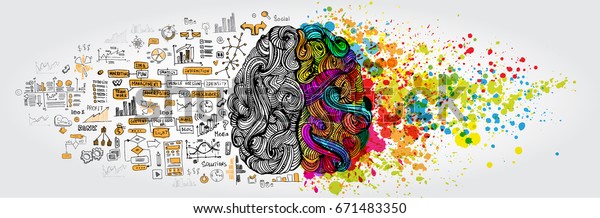
Left right human brain concept. Creative part and logic part with social and business doodle

Saturday, July 25, 2020

Can we have less numbers and more stories, please?

The countries with more poverty and/or more inequality are facing a tough time in controlling the current Covid19 pandemic. Anyone living in the countries having an extremely high number of infected patients can confirm that people are less careful now than they were a few months back. Why is it like that? Of course, an obvious reason is that people are fed up with the long lockdown periods. We shall briefly discuss another possible reason, viz. statistics!

Because of my background and profession, I am a strong believer in numbers and statistics. We engineers can achieve amazing things by putting our trust in numbers. So much so that I would dare call myself a follower of dataism (https://onlinelibrary.wiley.com/doi/abs/10.1111/npqu.12080)! I can trust my data. I can calculate the uncertainty of a circuit if I know the uncertainties of individual components. Then we can give an estimate of the number of years after which one would definitely need to consider replacing that circuit.  (I.e. I take numbers as input and give numbers as output!)

But, let us say you tell me that the fatality rate from road accidents in Cape Town is 47 per day and that in Delhi is 5. And then you ask me how more careful should I be on the roads of Cape Town? I do not think I have an answer. Or if you ask me what more should I do in Cape Town roads to be more careful? I do not know! Do these numbers make me 9 times more careful in Cape Town?! I am pretty sure it does not. What does it even mean? (I.e. do not expect behavioural outputs from me by giving me numbers as input!)

The point is that, as expounded elaborately in the book "Thinking, Fast and Slow", humans are not designed to appreciate statistics! This is a major reason why putting a lot of number in daily news helps no one. Rather it makes our mind numb and makes us more careless.

What can be done? Remember the statement by good old Stalin: "a single death is a tragedy; a million deaths is a statistics"? Numbers rarely create emotions! What we need are more stories and fewer numbers. Even a single real story of real people will be more effective in hitting our empathy-spots and will help us relate to the realities. If we want qualitative output (of people becoming more careful and taking more precautions) then we need to give them qualitative input (of other people) and not quantitative. 

I would sincerely urge world-media to push more stories of Covid19 patients and their families: stories of both suffering and rejoice (on getting better), and try to limit the statistics. 

Saturday, July 04, 2020

Modern psychology in Buddhism.

Currently, I am reading a very interesting book, Thinking Fast and Slow (https://en.wikipedia.org/wiki/Thinking,_Fast_and_Slow). The writer, a Noble laureate, explains numerous experiments he had conducted and discusses a two-agent model of the human brain.

One of these agents is called System I, the agent which reacts without thinking. This is the part that is responsible for all human biases. There is a range of fascinating examples in the book which shows how biased we all are all the time. Then we have System II which is the more thoughtful and calculating agent. However, our brain is lazy. Hence, it rarely engages System II.

This reminded me of the Buddhist model of the brain. Thee is our "monkey mind" which is always jumpy. It can never settle or seat in peace. (https://www.huffpost.com/entry/buddha-how-to-tame-your-m_b_945793) This is so similar to System I. And then we have the "noting mind" the part which can observe things without any bias. This is so similar to System II. https://www.insightmeditationcenter.org/transcribed-talks/noting/

Found on Bing from www.clipartpanda.com | Cartoon clip art, Monkey ...

Thursday, June 18, 2020

Does Pooh love honey?

Pooh: I love honey. Don't you Piglet?
Piglet: But, Pooh, I brought honey for you last night. You did not eat it!
Pooh: Ah, I already have had two jars of honey by the time you came.


Does Pooh-bear really love honey? If he really loved it, he would have been able to eat it even after having two jars. I know, some of you may be thinking it is simple. It is the famous law of diminishing return. When you have more of something that does not give you as much fun/money any more!

Why does that happen?
Because we no more crave for it. Because we feel saturated. Because it does not feel as good anymore.


Ancient oriental philosophers took this argument to the next level. They suggested that we do not love or hate things or people or events. We love or hate the sensations created in our senses due to these things or people or events. When Pooh has had two jars of honey, the next jar is not going to create the same sensation as the first jar.


So does Pooh love honey? No! Pooh loves the "sensation" that honey creates. Replace honey with anything else that creates the same sensation, Pooh will love that as well. The same logic goes for hate as well.


My father discussed this with me a few weeks back. I felt numb thinking about it. It is as if, and correctly so, there is an opaque layer between me and the things/persons/events I am interacting with. I can not directly interact with objects/persons/events. They create sensations in my sense-organs and those sensations are the things I react to. (Note that in Oriental philosophy certain parts of the brain are also sense-organs as it senses different thoughts!)


When I say "I like xyz", it means nothing; and when I say "I hate xyz", it means nothing! How do we live in this opaque cocoon? Especially when we know that our feelings are impermanent (or anicca/anitya)? After one night, Pooh will get back his craving for honey.


This will need further musing. But as of now, there are two observations.


  1. First of all, we do not love/hate the objects/persons we interact with. We love/hate the sensations these objects/persons create in our sense-organs.
  2. Secondly, these sensations are fleeting and highly impermanent!


11 Food-Loving Cartoon Characters

Monday, May 11, 2020

Fear of Missing Out: Abhinibesha

Most people think that the fear of missing out (FoMO) is a result of the new age digitization and social media. But if we go by the phrase itself, it can be defined in a much broader manner. It can also be linked to the indecisiveness we experience when presented with many equally alluring options in life. For example, imagine that as a new graduate you got a job in the nation's defence research wing and another job in a private company making microchips! This is a bifurcation where you have no idea which one is the better choice. Each one will soon bifurcate into very very different lives. Once in, you can not come back and go the other route. You have missed a complete life! That is really tough FoMO! Neither of these lives is worse or better. Both are equally enrichening. And that makes it worse. You know that both routes are equally beautiful BUT different. This is unlike the choice Neo (in the movie Matrix) had. What do you do? You feel scared and stunned. 

Let us take another point of view. Let us try to understand what is fear. Why are we afraid of anything? I think the musing may get easier if we take a really big fear, the fear of death. The fear of death is so symbolic in oriental philosophies and psychology that they have a separate name for it abhinibesha.  Why are we afraid of death? I think this is mostly because of the massive number of unknowns that come after death. No one knows. The life I am so used to ends. And I have no idea what comes next. Absolutely no idea. I do not want to lose my grip on the known. Two main things bother me. Will the things I love so much continue? Will the things I hate come later? Because in real life I am not happy exactly. I still have things/experiences I do not like; and I still have things/experiences I like too much to lose. Researchers have found exactly the same (i.e. unhappiness) as a major cause of social-media-based FoMO (https://www.sciencedirect.com/science/article/pii/S0747563213000800).  But most of us are unhappy to different degrees. Hence, we all have FoMO. And the most apparent FoMO is the fear of death! By extrapolation, I hypothesize that those who take jumps in life should have less FoMO and less fear of death. It can be career/continent jumps or literal jumps (as done by adrenalin junkies). 

So how do I get rid of FoMO? Or at least not get bewildered by FoMO? (Of course, here FoMO means all kinds of FoMO starting from missing your friends's Facebook status to missing a whole new job to the fear of death.) I guess the simplest and easiest step might be to ride a roller-coaster! Experience, observe and immerse in the feeling of fear. Maybe force yourself to hop careers and countries. Who knows these experiences may teach us lessons that make us less fearful of changes and less fearful of the unknown and the missed messages!

PS: I am fully aware of the Yogic expounding of the fear of death and how it is linked to the false perception of individual personality and free-will. However, though I know it, I have not "felt" it yet. So for now I will rather keep jumping to deeply understand fear!

(Note on the image: This is the image of the phase space of a chaotic system. It shows how bifurcations lead to never repeating tracks. Once you take one path, your life is completely unique! )

Annual Review of Chaos Theory and Bifurcations and Dynamical ...


Wednesday, April 29, 2020

Life is a goat!

There is an interesting story that my grandfather told me a long time back. There was a man with a few goats. He was once going to the big market in the nearby village to sell one of his goats. Three charlatans saw him and made a plan! One of them came to the man and told "Hi, brother. How are you? Where are you going with this dog?". The man rebuffed him telling "This is a goat you blind one!". After a few minutes, another of the three guys came to the man and told "Hi, brother. How are you? Where are you going with this dog?". This time the man was not so sure. He told "Don't bother me. This is a goat!" After some more time, the third guy came to the man and told  "Hi, brother. How are you? Where are you going with this dog?". The man was really pissed. He thought he made a mistake. Maybe this is actually a dog. Then he left his goat and went home! 

A few days back a very melancholic thought struck me. Most of the elderly people I know in the west personally never give up the pursuit of money! Even at the age of 80 and something they would not do a single thing without payment. That made me think, will I also become like this when I am old? Is this the side-effect of living in the west? In some ways, it was like the WTF-moment that prince Siddhartha experienced. Prince Siddhartha (who later became the Buddha) grew up in a household where his father took every care to make sure that Siddhartha does not come across any of the difficulties of life. One day young Siddhartha was travelling through the capital and he saw a sick person by the road. He asked his charioteer, "who is this person and why is he suffering so much"? His charioteer, Channa, told, "Prince, this guy is sick". Then the prince asked, "will I also become sick?" Channa told, "yes my lord". 

Looking at the elderly in the west made me think, shall I also become like this when I am old? When so many people tell that life is a dog then you tend to doubt your own convictions. You tend to think that everyone will be like this when she/he grows old; stuck in the rat race of money and name.

A few days later, I was talking to an ex-student of mine who is teaching English in China. He was telling me this interesting experience of him where he came across a beggar playing an instrument in a busy street of China. While he was comprehending the beauty of a frail old mand completely lost in his own music in the midst of the chaos and cacophony of a busy Chinese street, for a few seconds time stood still. I have felt such fleeting feelings at times as well. Suddenly, I realised that even though most people say so, life is not a dog. Life is a goat! 

Vector Cartoon Illustration Of Cute Muslim Man Pulling The Goat ...

Thursday, April 09, 2020

Positive News During the Covid-19 Pandemic


One of the great quotes from Hollywood is "hope is a beautiful thing" (from Shawshank Redemption). In these times of #covid19pandemic we do need positive news to keep up our hope in the future and our hope in mankind. 
I have taken it upon myself to collect five positive news every few days and share with people I know. 

Due to my background, most of these will be related to #innovation and #engineering. You may follow me on Tweeter (@mister_mangu) for these updates. 
Else you can visit this blog where I maintain an archive of these pieces. #fightagainstcorona #positiveenergy #goodnews #covid19southafrica #covid19news 

05-May-2020

  1. The science barometer has reported record-high confidence of people in science (in Germany). Would it mean that post-Covid19 society would be a more pragmatic and logical society with less scope for hate and more for truth and love? https://www.wissenschaft-im-dialog.de/projekte/wissenschaftsbarometer/wissenschaftsbarometer-corona-spezial/ 
  2. In my last list of positive news, we read about EU's initiatives towards running united research to fight Corona. A global fundraising was started on the 4th of May. It has already met its $8 Billion target!  #UnitedAgainstCoronavirus https://researchprofessionalnews.com/rr-news-europe-innovation-2020-5-8bn-covid-19-r-d-target-met-with-1bn-from-horizon-2020/
  3. The virus is mutating. But contrary to Hollywood mutation these virus mutations are making it weaker. It also makes a little bit of common sense. Mutations are mostly supported by the organism's chances of survival. A virus survives longer if the host lives. Hence, the death of a host is a bad grade for the virus! So as they get better at survival strategy they should get less lethal. Again, I am no virologist. I may be absolutely wrong. But mutations are happening and they are making the virus weaker. https://www.dailymail.co.uk/health/article-8286181/Coronavirus-mutation-one-sample-signal-getting-weaker.html
  4. Following the logic of double-negative, here is a piece of positive news based on the disproving of negative news! News around reinfections were false-positives! https://www.theguardian.com/world/video/2020/may/03/coronavirus-reinfections-were-false-positives-says-who-technical-lead-video
  5. And some nice stats as always. The total number of recovered cases is now more than 1.1 million. Rate of increase of cases in Germany has been less than 1% and in the USA has been less than 3% for ten days. And Singapore is still one of the best warriors with less than 0.09% death rate. And yes, 80-90% of the cases in India are asymptomatic!


26-April-2020

  1. Accepting freebies is a shame in traditional Indian culture. Some people still believe in it. Some migrant labourers in Rajasthan were quarantined in a local school. In return for the care and free-food, they painted the whole school building! https://thelogicalindian.com/latest-news/migrant-workers-paint-quarantine-school-sikar-20760 #dignity 
  2. In spite of jaw-dropping numbers, the infection increase-rates are actually easing in the USA. The rate of increase in the numbers of new cases has consistently stayed below 5% for the past two weeks
  3. Many might have missed the phenomenal news that the world's first portable MRI machine has got FDA approval during the Corona outbreak. Such instruments will be crucial in fighting pandemics. https://www.goodnewsnetwork.org/fda-approves-worlds-first-portable-mri-scanner/
  4. Innovators are working round the clock in enabling us to fight the pandemic. Here is an excellent list of such innovations. https://www.weforum.org/agenda/2020/04/coronavirus-covid19-pandemic-gadgets-innovation-technology/ #innovation While we are at it, let me also state that entrepreneurs are the happiest people working! https://www.forbes.com/sites/elainepofeldt/2014/03/05/survey-entrepreneurs-are-happier-than-employees/#544cdaea62d9
  5. Disasters unite. Global disasters unite the globe! Major world organisations are inviting all countries and organisations to join hands in the fight against Covid_19. https://ec.europa.eu/commission/presscorner/detail/en/qanda_20_731  #UnitedAgainstCoronavirus

17-April-2020

  1. Germany has been one of the most successful nations in terms of tackling Covid-19. In an important meeting, held on 15th April, the Chancellor discussed how the restrictions shall slowly be eased. They aim to open the schools on 4th of May. https://www.bbc.com/news/world-europe-52299358 
  2. In spite of jaw-dropping numbers, the infection increase-rates are actually easing in the USA. The rate of increase in the numbers of new cases has consistently stayed below 7% since 11th April 2020. 
  3. In spite of the growing number of new cases, the effective number of patients under treatment (i.e. infected - recovered) has stabilised in some of the worst-hit nations like Spain and Italy. It actually has been decreasing in Germany. 
  4. A major aim behind any drastic measures like border-sealing or lockdown must be to buy time to get prepared. Finland closed borders to its worst-hit state of Uusimaa on 28th March. They have been preparing the medical facilities in other parts so long and shall mostly lift the blockade next week. https://yle.fi/uutiset/osasto/news/daily_govt_not_planning_to_extend_uusimaa_border_closure/11303010 
  5. The government of Odisha (in India) took an out-of-the-box step in dealing with Covid19. They employed Mr. Subroto Bagchi (https://en.wikipedia.org/wiki/Subroto_Bagchi), the ex-director of a successful IT company (Mindtree: https://en.wikipedia.org/wiki/Mindtree) to manage the state's response. During the ongoing lockdown, Bagchi's team has been working in exemplary manner and now they have prepared 36 new hospitals in all major cities of the state to face the waves when the lockdown is finally lifted.    https://www.ndtv.com/india-news/odisha-to-have-36-dedicated-hospitals-for-covid-19-patients-soon-report-2212462


09-April-2020

  1. Around 10,000 people recovered from Covid-19 just today (8-9 April 2020) in Spain and 13,000 in Germany.
  2. Govt. of India has launched an aggressive funding scheme (of around US$ 7.5M) for startups planning to work on developing products to enable the fight against Covid-19. https://isba.in/cawach/ 
  3. Round the world, countries, agencies and philanthropists are offering a massive amount of funding to entrepreneurs to help fight Covid-19. https://sciencebusiness.net/news/live-blog-rd-response-covid-19-pandemic 
  4. Finland, the happiest country in the world, seems to have been doing what every other country must be doing, i.e. to have a reserve of medical accoutrement. Apparently, they touched their medical reserve for the first time since WW II. https://www.nytimes.com/2020/04/05/world/europe/coronavirus-finland-masks.html 
  5. Companies around the world have been working on making easy to use inexpensive test-kits to facilitate large-scale testing. E.g. 
    1. Brazil: https://tinyurl.com/w6zhy8c 
    2. India: https://www.bbc.com/news/world-asia-india-52064427 
    3. Finland: https://tinyurl.com/rybcoro 
    4. Germany (Siemens): https://tinyurl.com/u3lwcj9 
    5. South Africa: In SA, they will use the existing TB test-equipments to speed up the testing. https://tinyurl.com/wqmbuar


 06-April-2020

  1. “Rate” of growth of the infection has been consistently decreasing in the USA for the past 15 days. https://tinyurl.com/uxh3fja
  2. India to double the number of ventilators by June using inhouse made ones. https://tinyurl.com/wkvj29d 
  3. Odisha govt. (in India) sanctions $70,000 to feed stray animals during the lockdown. https://tinyurl.com/vmk68cr 
  4. Doctor drives 540km to drop a patient home during the lockdown in India. https://tinyurl.com/wjfrkhs
  5. A rising number of startups working to fight #covid19 https://tinyurl.com/tys9w8j